
New Roof Estimate in Massachusetts: A Step-by-Step Guide

Updated: Oct 9
What if the lowest new roof estimate leaves out work your home actually needs? In Massachusetts, proposals for the same house can differ because they use different assumptions about roof dimensions, materials, existing layers, removal, and repairs beneath the shingles. Roof pitch, dormers, valleys, and access around the house can also affect the scope. A short total may look appealing, but clarity matters more.
Before making a roofing decision, you should be able to see exactly what the estimate includes. A useful estimate describes the planned work, materials, removal, and any conditional repairs, so you can compare proposals on more than price alone. This guide explains what information helps create a project-specific estimate, which scope details to review, and how to prepare for a productive roof assessment. It also covers roof-specific conditions to consider when planning a residential replacement in Massachusetts, including in MetroWest communities such as Waltham, Natick, and Hudson.
Table of Contents
What a New Roof Estimate in Massachusetts Should Tell You
A new roof estimate should describe a project, not just display a total. It should identify the planned work, proposed materials, and conditions that could change the scope. That detail matters in Waltham, where two homes with similar footprints can have different roof shapes, access constraints, or existing layers.
A useful roof estimate connects the home’s observed conditions to the work, materials, and assumptions behind the proposed replacement.
Which details shape a roof replacement estimate?
Roof area helps determine the amount of material and labor a project may require, but it is only one factor. A steep slope can affect safe access and installation planning. Dormers, valleys, and other changes in roof shape require additional detailing, while limited access around the house can affect how materials and removed roofing are handled.
Existing layers and visible damage matter, too. Removing multiple layers involves different work from removing a single layer, and damaged areas may need repair before new roofing is installed. Concealed damage may only become apparent as work progresses. A property assessment helps define visible conditions and establish a scope for the specific home, rather than relying on a quick estimate based on general assumptions.
What should the estimate document clearly?
Look for the proposed roofing material by type, along with descriptions of related components included in the assembly. If you’re comparing options, this overview of common roofing materials offers general background. The estimate should still identify what is proposed for your project rather than relying on a broad category alone.
The document should make the planned work easy to follow. Check whether it describes:
Removal of existing roofing and disposal of debris
Flashing work at roof transitions and penetrations, where applicable
Ventilation components included in the scope
Job-site cleanup and handling of removed materials
Repairs or other work that may depend on conditions discovered during the project
How to Prepare for an Accurate New Roof Estimate
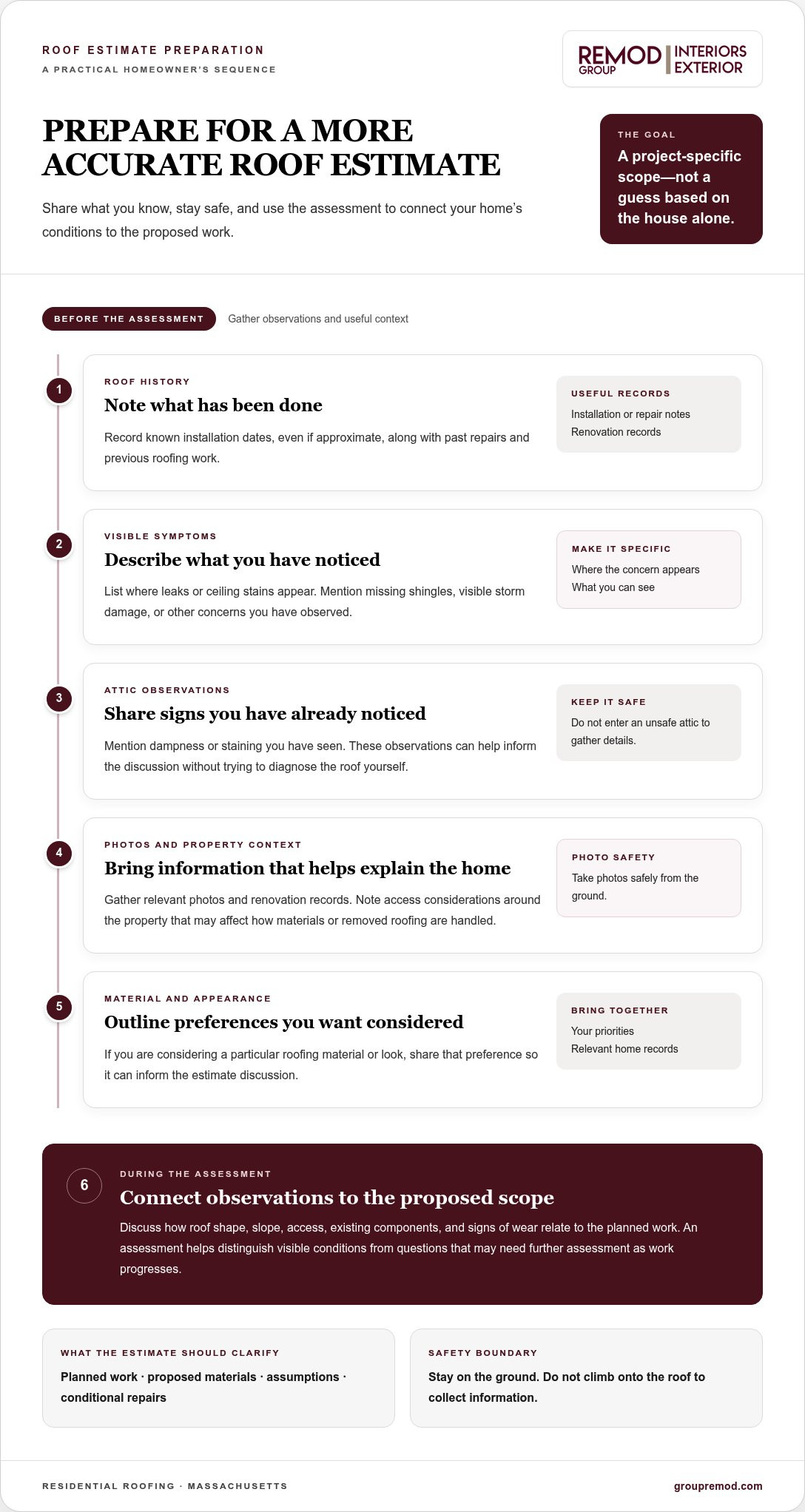
A little preparation helps make a roof assessment more useful. You do not need to diagnose the roof yourself. Share what you’ve noticed and what you know about its history, then use the assessment to connect those details to the proposed work. This gives a new roof estimate a stronger starting point than a brief description of the home alone.
What information should homeowners gather before an estimate?
Before the assessment, collect relevant records and observations. If you know when the roof was installed or repaired, note the date, even if it is approximate. Photos taken safely from the ground, renovation records, and a short list of concerns can make the discussion more specific.
Start with roof history: Record known installation dates, past repairs, and previous roofing work.
Document symptoms: Note where leaks or ceiling stains appear, along with missing shingles or visible storm damage.
Share attic observations: Mention signs you’ve noticed, such as dampness or staining, without entering an unsafe area.
Bring useful context: Gather relevant photos and renovation records, and note access considerations around the property.
Outline preferences: If you’re considering a particular material or look, share that preference so it can inform the discussion.
Stay on the ground. Don’t climb onto a roof or enter an unsafe attic to gather details. For general context on roof assembly provisions, homeowners can consult the Massachusetts State Building Code for Roofs. The project scope should account for the home’s conditions and applicable requirements.
What happens during a roof assessment?
An assessment connects visible conditions with the work a replacement may involve. Roof shape, slope, access, existing components, and signs of wear can all inform the scope. The observations help distinguish known conditions from questions that may require further assessment, rather than treating every roof as a standard project.
Share your notes and photos, then discuss how the observed concerns relate to the proposed work. A Waltham home may have roof features or prior repairs that aren’t apparent from a quick look at the exterior. An assessment helps build a project-specific understanding without assuming a fixed inspection method or duration.
For additional Massachusetts context, read this guide to residential roofing contractors. Remod Group provides roofing services in Massachusetts as part of its broader exterior construction work.
How to Compare New Roof Estimates Beyond the Bottom Line
A lower total doesn’t automatically mean better value, and a higher one doesn’t prove the scope is more complete. The figures may reflect different roof areas, material choices, removal assumptions, or repair allowances. Compare what each proposal says will be done before comparing totals. If the work isn’t equivalent, the prices aren’t directly comparable.
Which estimate line items deserve a closer look?
Review proposals side by side and mark what is specified, unclear, or absent. A blank or vague line does not necessarily mean a task is excluded, but it does leave room for interpretation. Write down questions and resolve material gaps in the scope before deciding.
Pay close attention to broad phrases such as “as needed” or “standard materials.” They don’t identify the exact work or product. An allowance also differs from a confirmed task: it makes room for a possible cost or repair, but may not explain what will be done if that condition arises. Look for who is responsible for each listed task and what could trigger a scope change.
How can homeowners judge whether estimates cover comparable work?
First, align proposals by roof areas and tasks. Then compare material descriptions and assumptions separately. For example, one estimate may include removal and disposal while another describes installation without saying whether old roofing is included. The totals may differ because the scopes differ, not because one price is inherently superior.
Make a simple checklist for each proposal: included, excluded, conditional, or unclear. Review underlayment, flashing, ventilation, site protection, and cleanup alongside the main roofing material. If one estimate lists a repair as conditional and another includes it, mark that difference instead of comparing the totals as if both proposals cover the same work.
A complete comparison turns the new roof estimate from a headline figure into a decision tool. Look for a scope you can understand, assumptions you can identify, and contingencies described in specific terms rather than hidden in vague wording. When working with professionals like Remod Group, clear communication during this comparison stage helps ensure transparency.
How Massachusetts Roof Conditions Can Affect an Estimate
A roof in Waltham or Natick faces seasonal conditions that can make assessment and planning more nuanced than a simple material change. Snow, ice, and wind-driven rain are useful context, but they don’t mean every home needs the same upgrades. A project-specific estimate should reflect the roof’s observed condition, design, and exposure.
What local conditions may change the project scope?
Start by considering how water moves across and away from the roof. Valleys, edges, gutters, and other drainage points can matter when assessing signs of water entry or ice-related concerns. Roof shape and slope affect exposure and how different areas perform. Nearby trees and shade may also influence how quickly sections dry or clear after winter weather.
Existing ventilation and roof components inform planning, too. A concern near an eave or valley, for example, may call for closer assessment of that area rather than an assumption that the whole roof needs identical treatment. In Hudson and nearby MetroWest communities, the home’s specific layout and observed condition matter more than a one-size-fits-all regional checklist.
For an overview of material considerations in cold-weather conditions, see this guide to roofing materials for New England winters. Consider material choices alongside the roof’s structure, components, and project scope.
When should a Massachusetts homeowner plan the estimate?
Start planning when you notice recurring concerns, aging materials, or signs that replacement may be approaching. Seasonal weather can affect when an assessment or roofing work is practical, and demand may influence scheduling discussions. Raising the project early gives you more time to understand the proposed scope and consider material choices before a problem becomes urgent.
An active leak is different from routine replacement planning. If water is entering the home, document what you can safely observe indoors and treat the issue as time-sensitive. Don’t climb onto a wet, icy, or snow-covered roof or attempt a temporary repair that puts you at risk. Share the location and timing of the leak during the assessment so it can inform the project discussion.
A clear new roof estimate considers local weather as context, not as a reason to prescribe identical work for every home. For residential roofing in Waltham and surrounding MetroWest communities, explore Remod Group’s roofing services as you plan the next steps for your home.
From New Roof Estimate to a Clearly Scoped Roofing Project
An estimate becomes useful when it leads to shared understanding. Before moving ahead, review the proposed work, resolve open assumptions, align on materials, and identify decisions that remain. This turns a new roof estimate into a clearer basis for planning, rather than a number you’re left to interpret on your own.
What should homeowners resolve before approving a roof scope?
Confirm that the written scope reflects the project you’ve discussed. Make sure the proposed materials and included tasks are clear, and that exclusions, allowances, or conditional repairs are identified. If an item depends on a condition discovered during the work, the document should explain that uncertainty in plain language. Written clarity helps you understand what’s planned and which decisions may still arise.
Review the scope: Check which roof areas and tasks are included.
Resolve assumptions: Clarify vague descriptions and note any conditional work.
Align on materials: Ensure the proposal describes the selected roofing material and related components.
Plan remaining decisions: Identify what still needs to be discussed before the project moves forward.
This review is not about anticipating every hidden condition. It’s about knowing what the estimate describes, what it leaves open, and how a change in observed conditions could affect the agreed scope. Clear communication now helps prevent different expectations about the work later.
How does Remod Group help homeowners plan exterior work?
Remod Group provides residential roofing as part of its exterior construction work in Massachusetts. Its local communities include Hudson, Natick, Sudbury, Waltham, Ashland, Hopkinton, Bolton, Northborough, Southborough, Westford, Stow, Maynard, Wayland, Concord, Weston, Wellesley, Sherborn, Acton, Boxborough, Berlin, Shrewsbury, Boylston, Newton, Needham, Dedham, and Dover. The roof is one part of a home’s exterior envelope. If a broader project also involves siding, windows, or doors, those elements can be considered in relation to the home’s needs rather than treated in isolation.
The next conversation can focus on your home: its roof, the concerns you’ve observed, and the scope you’re considering. Bring questions about the proposed work and materials, along with relevant roof history or photos. That context helps make the discussion specific to your project without assuming every home requires the same approach.
As you plan residential roofing in Massachusetts, take the next step and Discuss your roofing project with Remod Group.
Make Your Roofing Decision with Clarity
A clear new roof estimate does more than state a total. It explains the work, materials, and assumptions behind the project, giving you a stronger basis for comparing proposals. Gathering roof history and noting concerns before an assessment can help shape a scope around your home rather than a generic checklist.
As you review the details, keep Massachusetts weather and your roof’s specific features in view, then resolve unclear items before moving forward. Remod Group provides residential roofing as part of its broader exterior construction services in communities including Waltham, Natick, and Hudson.
Ready to discuss your home and the work it may need? Discuss your Massachusetts roofing project with Remod Group. A thoughtful conversation is a confident first step toward a clearly planned roofing project.
Frequently Asked Questions
What should be included in a new roof estimate?
A useful new roof estimate describes the proposed roofing materials and the work included, such as removal, underlayment, flashing, ventilation, disposal, and cleanup where applicable. It should also explain assumptions, exclusions, allowances, and repairs that depend on conditions found during the project. The exact scope depends on the home and its roof. Compare the written details line by line rather than relying on a summary figure alone.
How do I get an accurate new roof estimate?
Gather any known roof installation or repair history, note leaks and visible concerns, and share relevant photos or records. Be clear about material preferences and access considerations, too. An assessment can connect the roof’s condition and design to the proposed work. For a Waltham home, for example, mention where a leak appears and when you first noticed it. Don’t climb onto the roof; document concerns safely from the ground or attic.
Why do new roof estimates differ so much?
Estimates can differ because they use different measurements, material selections, removal assumptions, and approaches to possible repairs. One proposal might include a task that another treats as conditional or excludes. Compare each written scope line by line, including allowances and components, before drawing conclusions. Different totals don’t show by themselves whether proposals cover equivalent work or whether one estimate is more complete for your home.
Can I get a new roof estimate online?
Online tools can provide an initial estimate based on details such as an address, roof imagery, or homeowner answers. This can be useful for early planning, but digital information may not capture every roof condition or define the full replacement scope. Treat an online figure as preliminary guidance, not a substitute for understanding the project-specific work, materials, assumptions, and possible repairs before deciding how to proceed.
How much does a new roof estimate cost?
Estimate policies vary, so don’t assume every assessment has the same terms. For planning, focus on what information the estimate uses and what work it describes, including assumptions and possible conditional repairs. This guide doesn’t quote an assessment fee or roofing price. Review the project-specific estimate and its stated scope to understand what the proposal covers before making a decision about your home.
Is the lowest new roof estimate always the best choice?
No. A lower total may reflect a different material selection, fewer included tasks, or different assumptions about removal and repairs. Compare the roof areas, materials, components, exclusions, and contingencies in writing before judging value. If one proposal includes disposal and another doesn’t describe it, the totals may not represent equivalent work. The goal is to understand exactly what each scope proposes for your home.
When is the best time to request a roof replacement estimate in Massachusetts?
Start planning when you notice recurring leaks, damaged roofing, or other signs that merit an assessment. If water is entering the home, don’t wait for a more convenient season to address the concern; document what you can safely observe and share it during the assessment. Weather and seasonal demand can affect planning discussions. Homeowners in Waltham, Natick, and Hudson should review current local permit or inspection requirements before relying on specific guidance.

Comments